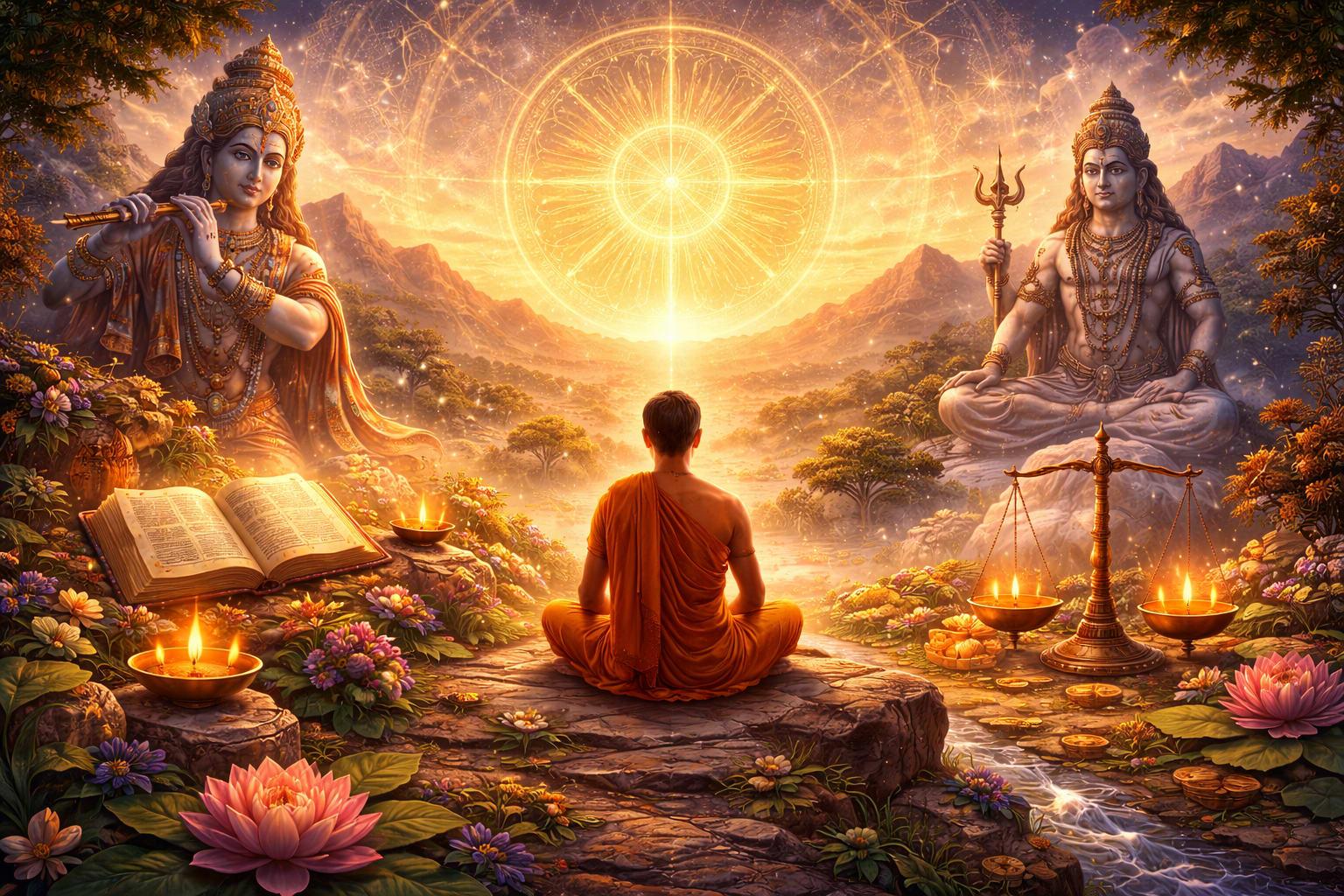
Karma, Dharma & the Purpose of This Human Life
Do not compare your path to another's. Do not abandon your authentic nature, trying to imitate someone else's excellence. Your Dharma—however imperfect, however difficult—is your unique sacred contract with the universe. Honour it.
You have prayed. You have aligned yourself with an auspicious time. You have chanted the sacred sound. You have stood in the presence of the Divine within the temple. You have danced in the joy of cosmic festivals. And now, as the lamp burns low and the silence deepens, a question rises—quietly, inevitably—from somewhere beneath all the ritual and celebration:
Why am I here? What is the purpose of this life?
It is the oldest question a human being can ask. And the Vedic tradition does not shy away from it. It answers with two of the most profound concepts ever articulated in the history of human thought—Karma and Dharma.
The Universe Runs on a Moral Law
Before we can understand Karma and Dharma, we must first understand the Vedic worldview that holds them. In the Hindu tradition, the universe is not a random accident. It is a conscious, ordered, purposeful creation, governed by the same principle of Rita (cosmic order) that we encountered when exploring sacred festivals.
The Rig Veda establishes this moral architecture of the universe from its earliest hymns:
"Ritam cha satyam cha abhiddhaat tapaso adhy ajayata."
"From the tapas of cosmic order were born both Rita—the cosmic law— and Satya—truth."
—Rig Veda, Mandala 10, Sukta 190
Truth and cosmic law are not separate. They are born together, from the same source. This means that the universe is not indifferent to how we live. It responds—perfectly, impartially, and without exception—to every thought, word, and action we generate. This response is what the ancient sages called Karma.
What Karma Really Means
Few words from the Sanskrit language have travelled as widely into modern usage as Karma, and few have been as thoroughly misunderstood. In popular culture, Karma has been reduced to a kind of cosmic revenge: "what goes around comes around." But the Vedic understanding of Karma is far more subtle, more compassionate, and more empowering than this.
The word Karma simply means action. Every action—physical, verbal, or mental—generates a consequence. Not as punishment, but as a natural law as precise and impersonal as gravity. Drop a stone, it falls. Act from fear, and it generates more fear. Act from love; it generates more love. The Brihadaranyaka Upanishad states it with crystalline clarity:
"Yatha kraturbhavati tatha karoti, yatha karoti tad avapnoti."
"As a person's deepest desire is, so is their intention. As their intention is, so is their action. As their action is, so is their destiny."
—Brihadaranyaka Upanishad, 4.4.5
This is not fatalism. It is the opposite; it is the most radical declaration of human freedom ever made. You are not a victim of circumstance. You are the author of your own destiny, writing it line by line with every choice you make.
The Bhagavad Gita refines this understanding further, introducing the transformative concept of Nishkama Karma, action without attachment to its fruits:
"Karmanye vadhikaraste ma phaleshu kadachana, ma karma phala hetur bhur ma te sangostvakarmani."
"You have the right to perform your actions, but never to the fruits of your actions. Let not the fruits of action be your motive, nor let attachment to inaction be your refuge."
—Bhagavad Gita, Chapter 2, Verse 47
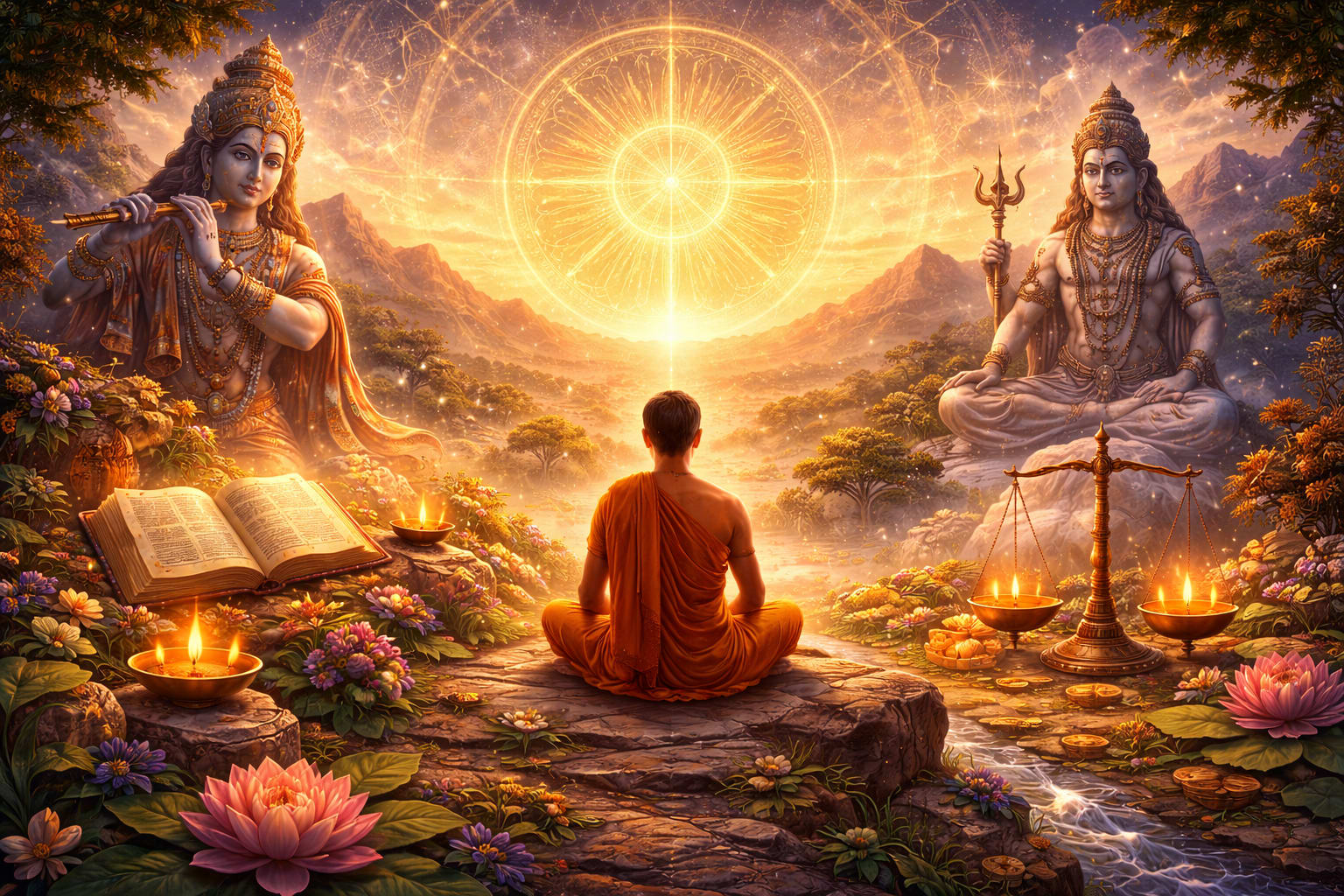
This single verse contains perhaps the most liberating spiritual instruction ever given. Act fully. Act excellently. Act with complete sincerity. But release the outcome to the Divine. When you do this, your action becomes not just work—it becomes worship. It becomes Karma Yoga—the path to the Divine through conscious, dedicated action.
What Dharma Really Means
If Karma is the law of action, Dharma is the law of being, the sacred duty, the right way of living, the unique path that is yours and yours alone to walk in this lifetime.
The word Dharma comes from the Sanskrit root Dhri—to hold, to sustain, to uphold. Dharma is that which holds the fabric of life, society, and cosmos together. Without Dharma, as the Mahabharata warns, everything unravels:
"Dharmo rakshati rakshitah."
"Dharma protects those who protect Dharma."
—Mahabharata, Vana Parva, Chapter 313
This is not simply a religious teaching. It is an ecological and social truth. When people live in accordance with their Dharma, their true nature, their true duties, their true purposes, families prosper, communities flourish, and the world remains in balance. When Dharma is forgotten, when people live inauthentically, exploit others, and live only for their own selfish desires, the fabric begins to fray. We see this truth at work in our modern world.
The Bhagavad Gita adds a deeply personal dimension to Dharma that is both demanding and liberating:
"Shreyaan swadharmo vigunah paradharmat svanushthitaat, swadharme nidhanam shreyah paradharmo bhayavahah."
"Better is one's own Dharma, though imperfectly performed, than the Dharma of another well performed. Better is death in one's own Dharma—the Dharma of another brings only fear."
—Bhagavad Gita, Chapter 3, Verse 35
Lord Krishna is making a radical point here. Do not compare your path to another's. Do not abandon your authentic nature, trying to imitate someone else's excellence. Your Dharma—however imperfect, however difficult—is your unique sacred contract with the universe. Honour it.
The Rarity and Preciousness of Human Birth
The Vedic tradition holds that the human birth is extraordinarily rare and precious; not a right, but a gift. Of all the forms consciousness can take in this universe, only the human form possesses the capacity for self-reflection, for devotion, for the conscious pursuit of liberation.
The Vivekachudamani of Adi Shankaracharya states with breathtaking directness:
"Jantunam nara janma durlabham atah pumstvam tato viprata, tasmad vaidika dharma margaparata vidvatta tato manana."
"Among all beings, human birth is rare. Among humans, to live with awareness and wisdom is rarer still. And rarest of all is to earnestly seek liberation."
—Vivekachudamani, Verse 2
This is not a statement designed to create pride. It is a call to urgency and gratitude. This human life—with its capacity for love, for inquiry, for devotion, for conscious choice—is a window of extraordinary opportunity. Every moment spent in unconscious drift, every day lived purely in the pursuit of comfort without any movement toward truth, is a moment of that precious window closing a little further.
The Four Purusharthas, Life's Complete Purpose
The Vedic tradition does not ask you to abandon the world in pursuit of the spiritual. It offers instead a breathtakingly holistic vision of human purpose through the Chatur Purusharthas, the four aims of life:
Artha—material prosperity and security. Kama—legitimate pleasure, love, and the enjoyment of beauty. Dharma—righteous living and sacred duty. Moksha—liberation, the ultimate freedom of the soul.
These four are not in conflict. They are a hierarchy; a progression. The Manusmriti and later the Arthashastra of Chanakya both affirm that a life well lived honours all four, in their proper proportion and sequence. Material security grounds us. Love and beauty enrich us. Righteous living refines us. And the pursuit of liberation elevates us beyond all limitation.
The mistake of our age is to pursue only Artha and Kama while neglecting Dharma and dismissing Moksha entirely. The Vedic tradition holds that a life lived this way—however successful by worldly measures—will always carry within it a hollow ache of incompleteness.
Karma, Dharma, and the Path Forward
Here is the great synthesis the Vedic tradition offers: your Karma and your Dharma are not separate forces pulling you in different directions. They are two aspects of the same sacred path.
Your past Karma has placed you exactly where you are today: in this body, this family, this circumstance, this moment. This is not an accident. And your Dharma—your authentic duty and purpose—is the compass that shows you how to move forward from here with wisdom, love, and integrity.
The Katha Upanishad offers one of the most vivid images in all of Vedic literature for the human journey:
"Atmanam rathinam viddhi shariram rathameva tu, buddhim tu sarathim viddhi manah pragrahameva cha."
"Know the Self as the rider of the chariot, the body as the chariot itself. Know the intellect as the charioteer, and the mind as the reins."
—Katha Upanishad, 1.3.3
You are the rider. This life is the chariot. Your wisdom is the charioteer. And Dharma is the road. When all of these are aligned, when you act rightly, with awareness, from your deepest, authentic nature, releasing outcomes to the Divine, every action becomes a step toward Moksha, whether you are sitting in meditation or cooking a meal or conducting a business meeting.
You Are Here for a Reason
Prayer showed you the path. Panchang taught you to honour time. Mantra gave you the voice of the Divine. The Temple gave you a sacred space to meet the infinite. Festivals reminded you that the cosmos itself is celebrating. And now, Karma and Dharma reveal the deepest truth of all:
You are not here by accident. You are here with a purpose. And every conscious, dharmic, loving action you take is a step closer to the freedom your soul has always been seeking.
The Isha Upanishad opens with the most complete statement of this vision:
"Ishavasya midam sarvam yat kincha jagatyam jagat, tena tyaktena bhunjitha ma gridhah kasya svid dhanam."
"The entire universe is pervaded by the Divine. Enjoy what is given to you through renunciation—do not covet, for whose is wealth truly?"
—Isha Upanishad, Verse 1
Live fully. Act rightly. Love deeply. Release freely. This is Dharma. This is the purpose of this precious, unrepeatable human life.
At Prarthanaverse, every ritual we facilitate is an invitation to live more consciously—to align your actions with Dharma, to offer your Karma to the Divine, and to walk your sacred path with grace and devotion.
Om Tat Sat. 🙏