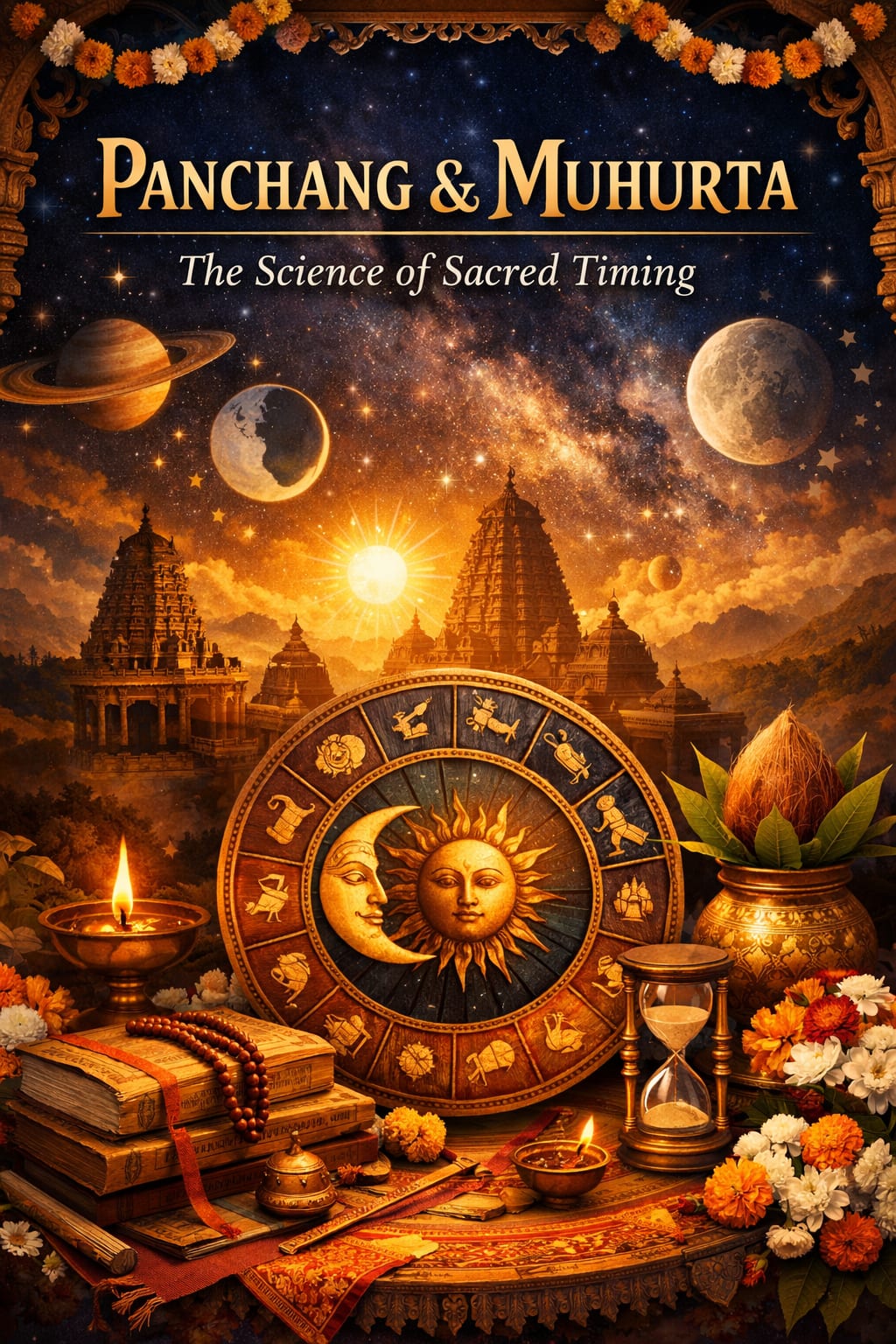
Panchang & Muhurta: Ancient India’s Science of Cosmic Timing
Time has brought forth all that was and all that will be. Time creates all beings. Time shines like the sun through tapas, through its own radiant energy.
We are living in a world that is driven by deadlines, reminders, and back-to-back schedules. And yet, despite all the advanced tools that we have at our disposal to manage time, we still feel as if we are racing against it. What is even more fascinating is that our ancestors had already unlocked the secrets of not only managing time but also “understanding” it at a cosmic level, thousands of years ago. This knowledge has been passed down through the ages in the form of the “Panchang”, which is an ancient science.
What Exactly is a Panchang?
The term ‘Panchang’ is derived from Sanskrit, where ‘Pancha’ means ‘five’ and ‘Anga’ means ‘limb’. Panchang is the Hindu almanac that monitors the five major aspects of time on a daily basis: “Tithi” (Lunar Day), “Vara” (Day of the Week), “Nakshatra” (Lunar Mansion), "Yoga" (Auspicious Combination), and "Karana" (Semi-Lunar Day).
The origin of this practice dates back to the “Vedanga Jyotisha”, which is one of the six auxiliary sciences of the Vedas and is exclusively concerned with the study of time and astronomical observations. It begins with a very profound statement:
"Yatha shikha mayuranam, naganam manayo yatha, tadvad vedanga shastranam, jyotisham murdhani sthitam."
"As the crest of a peacock, as the gem on the hood of a serpent, so stands Jyotisha at the crown of all the Vedic sciences."
— Vedanga Jyotisha
This is not astrology for entertainment. It is a very sacred science that the Vedic tradition placed at the very pinnacle of its intellectual structure, since the understanding of time was deemed absolutely necessary for living in harmony with Dharma.
The Science Behind Muhurta
What is a “Muhurta”?
A “Muhurta” is an auspicious moment of time—a moment when the cosmic forces are favorably aligned for a particular task. The Atharvaveda aptly recognizes the importance of time as a divine force in itself:
"Kalo ha bhutam bhavyam cha, kalah srijaati prajah, kalo amimita tapasaa, kaale surya ava tapati."
"Time has brought forth all that was and all that will be. Time creates all beings. Time shines like the sun through tapas, through its own radiant energy."
— Atharvaveda, Kanda 19, Sukta 53
This is known as the “Kala Sukta” and recognizes time not as a passive background of life, but as an active and living force. A Muhurta, therefore, is a moment when this living force of time is most favorably aligned with your goal.
There are various Muhurtas prescribed in ancient Vedic astrology for various tasks such as the start of a journey, the start of a business, the performance of a wedding ceremony, or the performance of a religious ritual. Just as a farmer recognizes the season and the soil before planting, our forefathers recognized that human endeavors, when in tune with the cosmic forces, have a much greater chance of success.
Panchang in Everyday Modern Life
You may ask, is the Panchang still applicable in today’s world, when we are booking flights, starting new businesses, and holding meetings in different time zones?
The “Vishnu Purana” has a very apt answer to this question:
"Kaalah kalayataam aham."
"Among all that measures and governs, I am Time."
— Vishnu Purana
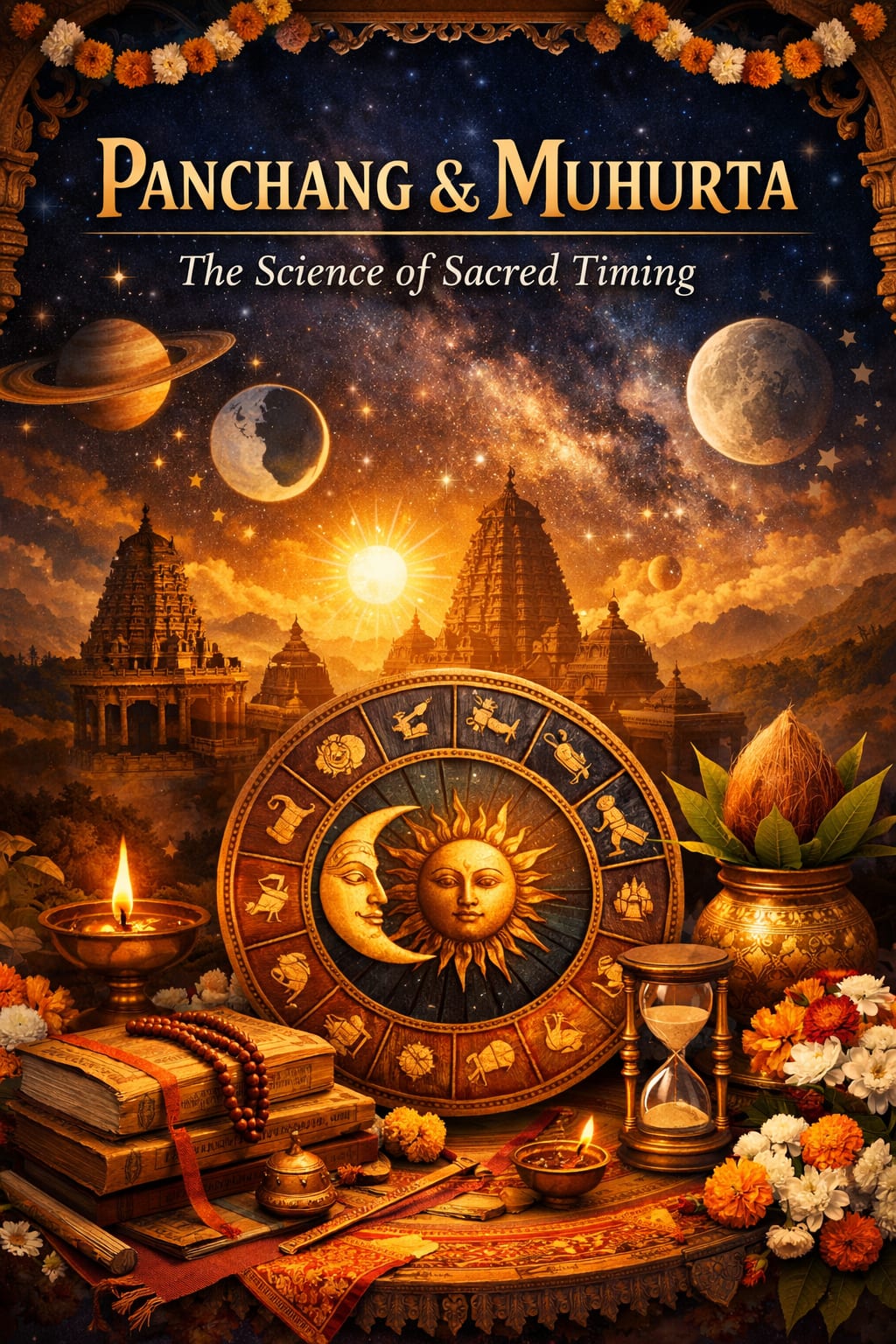
The association of Lord Vishnu with Time itself reveals that the importance of the Panchang is, in fact, the importance of the Divine order that pervades all of creation. There are many successful Indian families and professionals who secretly follow the Panchang before making important decisions; for example, when to start a new business, when to register a property, and when to send the kids to school for the first time. This is not mere superstition. This is, in fact, the incorporation of ancient wisdom into modern living.
Even modern science verifies this line of thinking in its own way: the existence of circadian rhythms, the influence of the lunar cycles on human biology, and the impact of seasonal changes on moods and productivity all point to one thing: timing is everything. The Panchang merely takes this wisdom to a much deeper and more subtle level.
Auspicious Timings for Your Poojas
One of the most useful ways to use the Panchang is to find the correct timing for your daily and festival poojas. In the “Taittiriya Brahmana”, which belongs to the Krishna Yajurveda school, it is strongly recommended:
“Ritasya pantha anuveda ehi.”
“Follow the path of cosmic order; this alone is the true Veda.”
Doing a pooja at a Shubh Muhurta is an act of following this cosmic order. The sankalpa you make, the mantras you recite, and the offerings you make are all imbued with more spiritual power when done in harmony with the rhythm of that moment. It is the difference between swimming with the tide and swimming against the tide.
This is why at Prarthana Verse, we provide you with the daily Panchang so that your bhakti is not only from the heart but also from the cosmos.
Ancient Clock, Timeless Wisdom
In a world that is always in a rush, the Panchang reminds us to stop and think: "Is this the right time?" It shows us that while hard work and intelligence are important for success, they are not the only factors. Timing, or the harmony of the universe that we are a part of, is also crucial.
The Atharvaveda's Kala Sukta concludes with a prayer that is as relevant today as it was in ancient times:
"Sa no muhurto abhi rakshatu devah."
"May that divine Muhurta protect and bless us."
The universe has its own pace. Once we understand how to live in harmony with the universe, instead of against it, life becomes an experience that no to-do list or productivity app can provide.
Read today's Panchang on Prarthanaverse and begin your journey to living in harmony with the universe.
Om Tat Sat.