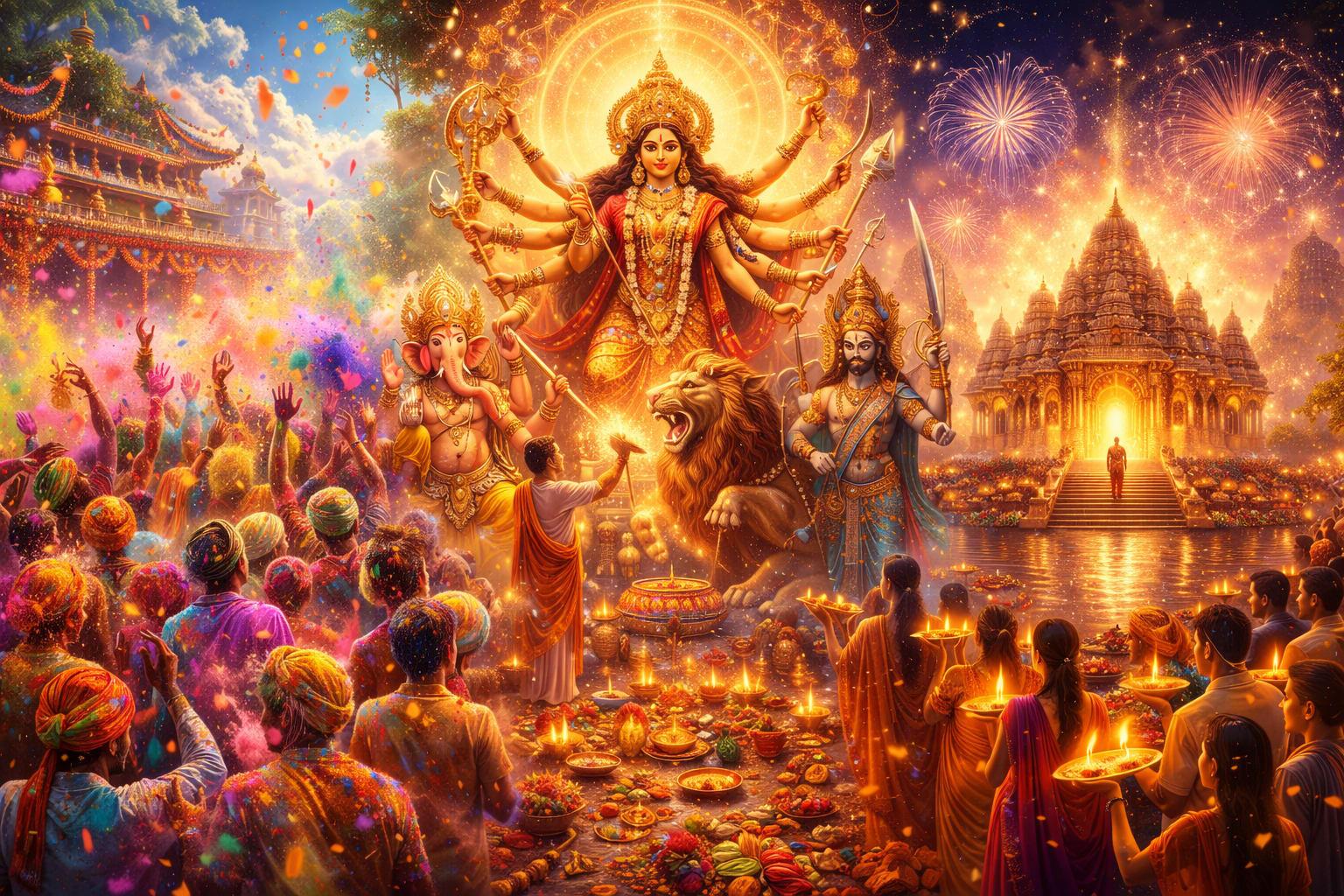
Sacred Festivals: Why Hindu Celebrations Are Cosmic Events, Not Just Holidays
Every Hindu festival is a scientifically calculated phenomenon in time and space: a fleeting moment when the divide between the human and the Divine becomes thinner than usual, when the cosmic energies converge in a particular pattern in the universe.
Every year, without fail, they turn up – Diwali with its sparkling array of diyas, Holi with its kaleidoscope of colours, Navratri with its nine nights of fervor and dedication, and Makar Sankranti with its golden harvest of gratitude. To the casual eye, Hindu festivals may look like any other colourful celebration of culture and heritage: time to indulge in sweet treats, time to bond with family and friends, and time to celebrate colourful traditions and customs. But look beyond the surface, through the prism of the Vedic philosophy, and you'll find something rather incredible.
Every Hindu festival is a scientifically calculated phenomenon in time and space: a fleeting moment when the divide between the human and the Divine becomes thinner than usual, when the cosmic energies converge in a particular pattern in the universe, and when human fervor reaches unprecedented heights.
The Universe Has a Calendar, and the Rishis Read It
The ancient sages did not create these festivals on a whim. They were highly precise astronomers, ecologists, and spiritual scientists. What they found out was that there are certain moments during the cycle of existence when certain divine energies are more accessible, more powerful, and more receptive to our prayers and intentions.
The Rig Veda recognizes this law of the cosmos since its earliest hymns:
"Ritam cha satyam cha abhiddhaat tapaso adhy ajayata, tato ratryajayata tatah samudro arnavah."
"From the great tapas of cosmic order—Rita—were born truth, night, the ocean, and all of existence."
— Rig Veda, Mandala 10, Sukta 190
Rita, or Cosmic Order, is the invisible law that governs everything from the movement of the stars to the change of the seasons to the observance of festivals. When we celebrate a festival on a particular day, we are not celebrating a tradition made by humans. We are celebrating a tradition made by Rita.
Navratri: Nine Nights of Cosmic Feminine Power
Of all the festivals in the Hindu calendar, Navratri is the one that best exemplifies the relationship between celestial timing and spiritual practices. Held four times a year, with both Sharad Navratri in autumn and Chaitra Navratri in spring being the most popularly celebrated ones, these nine nights coincide precisely with celestial events when solar and lunar energies make a dramatic shift.
The Devi Mahatmya, also known as Durga Saptashati—the scripture that forms the foundation of all Shakti worship—explains why these nine nights are so special:
"Ya devi sarva bhuteshu shakti rupena samsthita, namastasyai namastasyai namastasyai namo namah."
"Salutations to the Goddess who dwells in all beings as pure Shakti—energy itself. We bow to Her, again and again."
— Devi Mahatmya, Chapter 5
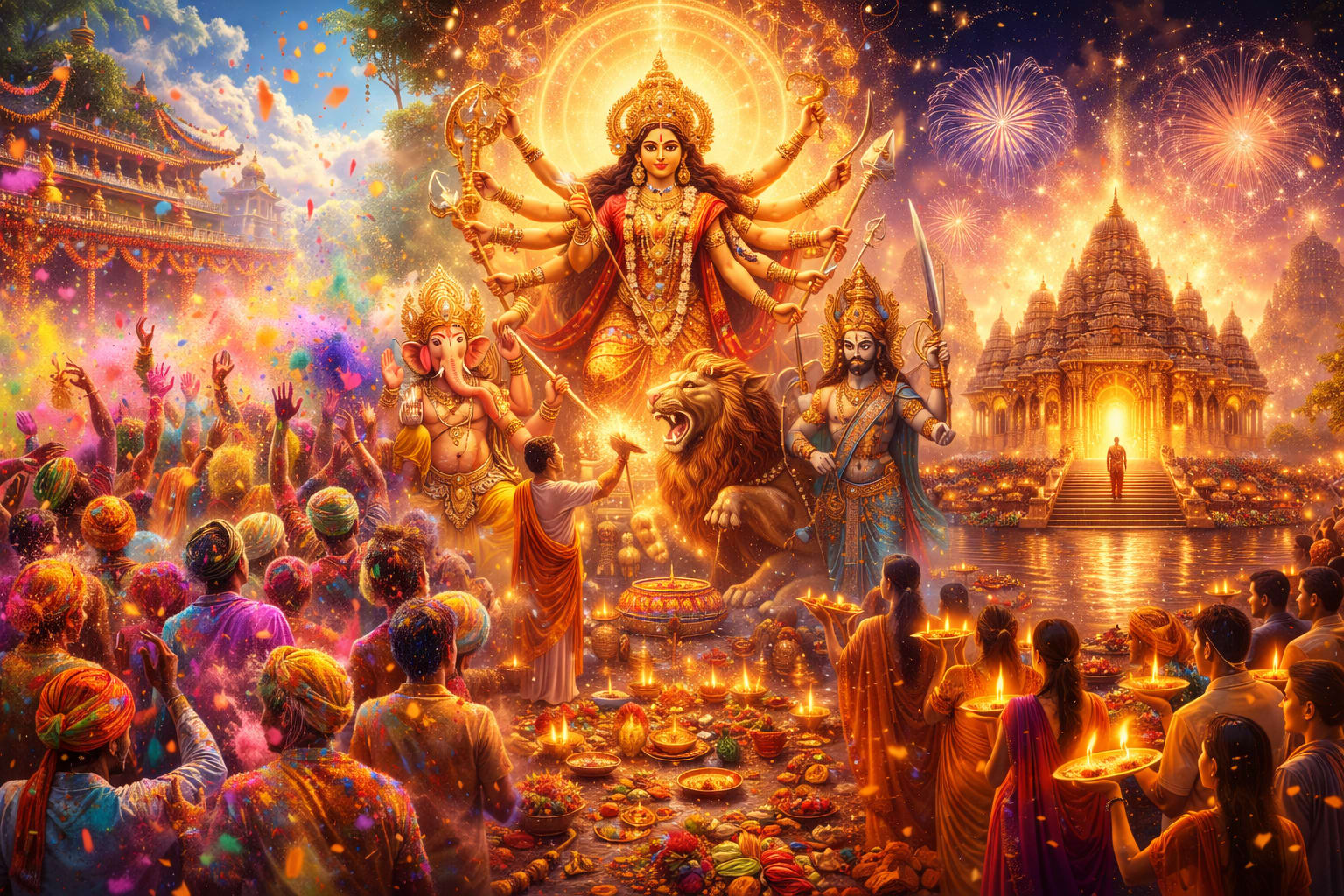
During Navratri, the earth itself is supposed to receive an amplified charge of energy from the Divine Mother. Fasting, prayer, dance, and worship during these nine nights is not merely religious exercises; they are spiritual exercises. The body, purified through fasting, is a refined receiving device. The mind, focused through prayer, is a clear receiving device. And then there is the collective energy of millions of people worshipping simultaneously—a field of consciousness of incredible potency.
Diwali: The Festival of Inner Light
Perhaps the most universally popular of all Hindu festivals, Diwali has at its core a rich spiritual message that has its roots in Upanishadic philosophy.
The most widely quoted prayer in all Hindu scripture can be found in the Brihadaranyaka Upanishad, and it has much to do with the essence of Diwali:
"Tamaso ma jyotirgamaya, mrityor ma amritam gamaya, asato ma sadgamaya."
"Lead me from darkness to light, from death to immortality, from the unreal to the Real."
— Brihadaranyaka Upanishad, 1.3.28
Every diya lit during Diwali night is in effect a physical expression of this ancient Hindu prayer. The darkness of Amavasya, or the night of the new moon, has been specifically chosen as the background against which all these diyas are lit. The message here is clear: in all darkness, one spark of consciousness is enough. The return of Lord Rama to Ayodhya is celebrated in Diwali, but it is also the return of light to each and every heart that has strayed into its own darkness.
Makar Sankranti: The Sun's Sacred Journey
Unlike most of the other Hindu festivals that are celebrated according to the lunar calendar, Makar Sankranti is a purely solar festival that is celebrated on the day when the Sun enters the constellation of Capricorn or Makara in the Sanskrit calendar. This marks the beginning of the Sun's journey towards the north, called Uttarayana.
The spiritual significance of this transition of the Sun was described in the Bhagavad Gita:
"Uttarayanam shad masah divo yasya maharsayah, prajajvalita jyotishaam brahma te yanti."
"Those who depart during the six months of Uttarayana, illumined by the light of knowledge, reach Brahman — the Supreme."
— Bhagavad Gita, Chapter 8, verse 24
The great warrior Bhishma Pitamaha, lying on his bed of arrows after the war of Kurukshetra, deliberately held on to his life force, waiting for Uttarayana to begin before he left, so that his soul's journey would be undertaken under the most auspicious solar conditions. This one story from the Mahabharata illustrates how deeply the ancients understood the relationship between the cosmic cycles and the journey of the human soul.
Makar Sankranti is not just a harvest festival; it is a day to realign with the ascending solar energy – let go of what is in the past, offer it into the sacred fire, and turn your face towards the light.
Holi: The Festival of Divine Love and Surrender
Holi falls on the full moon of Phalguna, the last full moon before the spring equinox. This marks the moment when the earth is on the verge of transformation, when winter releases its hold on the earth and new life bursts forth from the earth.
At the spiritual heart of Holi is the tale of Prahlada, the young devotee who was saved from all harm by his unshakeable devotion to Lord Vishnu. His declaration of the truth of the devotee is given in the Bhagavata Purana:
"Na te viduh svartha gatim hi Vishnum, durasaya ye bahir artha maninah."
"Those who seek meaning only in the outer world do not know that the true goal of all life is Vishnu—the all-pervading Divine."
The explosion of colours on Holi morning is the external manifestation of this inner reality: "For when all barriers disappear, when caste, status, age, and difference of every kind are washed away in a kaleidoscope of joy, what remains is the pure and unadulterated consciousness which pervades all existence. Holi, in its deepest reality, is an invitation to experience, even for a few happy hours, the reality of non-duality which the great sages had described in the Upanishads."
Why Collective Celebration Amplifies Spiritual Power
One of the most striking things about Hindu festivals is that they are almost never undertaken in solitude. They are created for communal participation, where the whole family, village, city, and in turn, the entire nation, participates in the same act of devotion at the same time.
The Taittiriya Upanishad says:
"Sahana vavatu, sahanau bhunaktu, saha viryam karavavahai."
"May we be protected together, may we be nourished together, may we create strength together."
— Taittiriya Upanishad, Shanti Path
Modern studies on consciousness have found what the Vedas have always said: when a large number of people meditate, pray, or concentrate their intention together, the effects can be felt far beyond their individual selves. The collective coherence of their devotion is exponentially magnified beyond the sum total of their individual prayers. This is the secret power of the festival: millions of hearts, orchestrated by tradition and history, broadcasting the same frequency of gratitude and love into the universe at exactly the same instant.
You Are Invited to the Cosmic Celebration
Prayer has opened your heart. Panchang has taught you to respect time. Mantra has become your sacred voice. Temple has become your sacred space. And now, Festival reveals to you the greatest truth of all: that the whole cosmos is itself engaged in an eternal and magnificent act of divine celebration, and that you are cordially invited to join in.
The Atharva Veda concludes this invitation with these words, which have echoed across millennia of time:
"Aa vo raja varuno yasya vratam na minanti bheshajam, suvati vishwabheshajam."
"Come; the Divine King Varuna, whose sacred order none can break, pours forth the healing medicine of the cosmos for all."
— Atharva Veda, Kanda 4, Sukta 16
Do not look upon this festival as something outside yourself. Step into it. Light the Diya. Chant the Mantra. Offer the flower. Touch the colours. Participate in the ritual, either at a Temple near you or across the sacred bridge of Prarthana Verse that joins your heart with India's holiest temples.
Because a festival fully lived is not an escape from life. It is life, experienced at its most luminous and most real.
Participate in upcoming sacred festival rituals at temples across India through Prarthanaverse and let the cosmos celebrate through you.
Om Shanti. Shanti. Shanti. 🙏