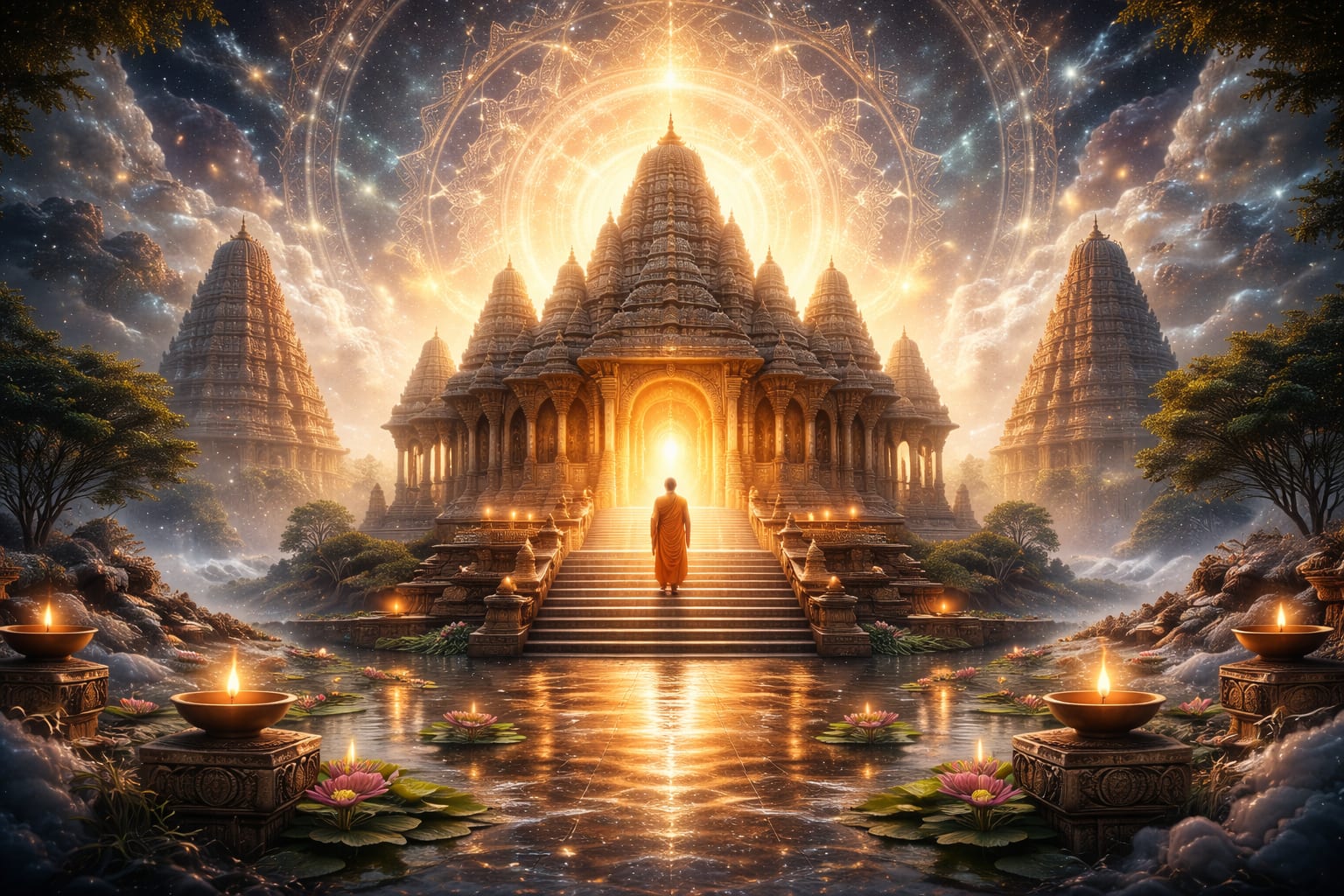
The Hindu Temple: A Portal to the Divine, Not Just a Place of Worship
For centuries, the temple was the very heart of all Hindu communities: not only the place of worship but also the hub of learning, music, art, medicine, and culture. The temples of Madurai, Tirupati, Somnath, and Varanasi were not only places of worship but also civilizations unto themselves.
You have prayed with sincerity. You have chosen your moment well. You have allowed the mantra to flow through you like a sacred river. Now, let us imagine ourselves stepping across the threshold of an ancient temple, our bare feet touching cool stone, the scent of jasmine and camphor enveloping us, and the faint tolling of bells drawing us inward and deeper. Something shifts as soon as we cross the threshold. The world outside recedes.
This is no accident or sentimentality. The Hindu temple is one of the most sophisticated spiritual tools ever devised by human civilization: a living, breathing, cosmically designed space designed to bring us into direct connection with the Divine.
The Temple as a Living Cosmos
According to the Vedic philosophy, the universe is not random but an ordered and conscious whole, which is termed Brahmanda—the cosmic egg of Brahma. The Hindu temple is the microcosm of the entire universe and is constructed according to the ancient Vedic sciences of Vastu Shastra and Agama Shastra.
According to the ancient text Manasara—the oldest text available on the architecture of temples:
"Prithivim devi mahabhagam lokam dharayate dhruvam, tasmin pratishthite deva sarvam dharayate jagat."
"The Divine Mother Earth holds the world steadfast. When the deity is established upon her, the entire universe is sustained."
— Manasara, Chapter 1
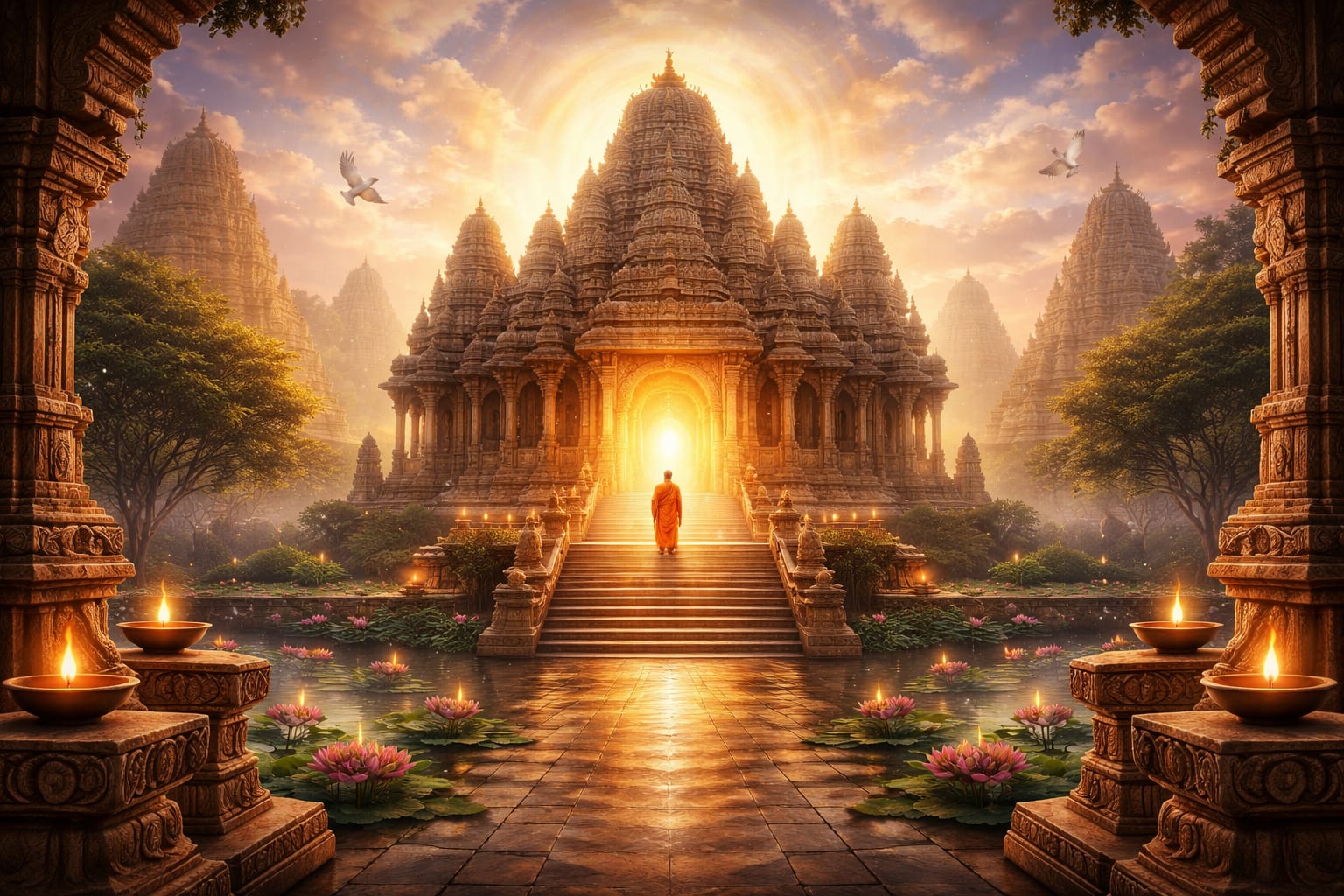
Each and every part of the temple's design is imbued with great meaning. The Garbhagriha – the sanctum sanctorum – represents the womb of creation – dark and silent – where the formless Divine assumes form. The towering Shikhara or Gopuram above it represents the axis connecting the Earth to the heavens – Mount Meru. The Mandapa – the hall where the devotees sit – represents the sky – the collective consciousness of humanity.
To walk through a temple is to walk through the entire universe, from the outer world of multiplicity toward the still center of the One.
Why the Murti is Not an Idol
One of the biggest misconceptions related to the worship of Hindu temples is the existence of the Murti, or the holy image of the deity. To the average person, this may seem like the worship of an idol. But the truth, as revealed through the Agamic texts, is far more beautiful.
"Archavatara is the form the formless Lord graciously assumes so that the devotee bound by human senses may behold, touch, and commune with the Divine."
— Agni Purana, Chapter 26
What is the Murti, really? It is not an idol, but a living entity, energized through the complex ritual of Prana Pratishtha, or the invocation of divine consciousness into the physical form. The ancient architects of the temples realized that through certain geometric formulas, metals, and stones, combined with the ancient knowledge of the Vedas, they could create a vessel that could house divine consciousness.
This is why the Garbhagriha feels like no other space that you have ever entered. The very atmosphere of the space has a stillness that is hard to put into words but impossible to deny.
The Temple as a Spiritual Technology
The Vishwakarma Vastushastra, the ancient sacred architecture manual, clearly states that temples must be built at places where the Earth's energy, which we would call geomagnetic fields, is high. Underneath many ancient temples, huge amounts of copper plates have been buried during the course of construction to increase the Earth's energy emanating upward through the Shikhara.
The Brihat Samhita, an ancient treatise by the great astronomer-sage Varahamihira, adds another dimension to the ancient wisdom:
"Yatra devo nivasati tatra sarve sukhino janah, arogya dhana sampannah sarvakama samanavitah."
"Where the Divine resides, the people are happy, healthy, prosperous, and fulfilled in all their desires."
— Brihat Samhita, Chapter 56
Ancient temples have never been built randomly but at very accurate geographic points, aligned with the sun, so that on certain days of the year, which are the festival days, the sun would shine directly on the form of the deity. This astronomical accuracy, as seen in temples like Konark or Kedarnath, reflects the immense extent of the knowledge of the ancient Indians.
The Daily Rhythm of Temple Life
A living temple inhales and exhales with the Shodashopachar, the sixteen acts of worship that the deity is offered from the time the sun rises until the night falls. The Agama Shastra, the scriptures that guide temple worship, says that the deity is like a divine guest, who has to be woken, bathed, dressed, fed, entertained, and sent to sleep with the same love that we would extend to any guest that we invite into our home.
The Narada Pancharatra is so beautiful when it says:
"Archanam sarva bhutanam, madhye Vishnum prapashyati, yah pashyati sa pashyati."
"One who sees Vishnu—the Divine—present in all beings through the act of worship, truly sees."
— Narada Pancharatra
The flowers, the flame of the aarti, the sacred water, and the prasad are all manifestations of love being offered to the formless, the divine, through the form that we see before us. And when the priest does all this for you, your intention, your sankalpa, becomes part of the ritual as well.
The Temple Beyond Geography
For centuries, the temple was the very heart of all Hindu communities: not only the place of worship but also the hub of learning, music, art, medicine, and culture. The temples of Madurai, Tirupati, Somnath, and Varanasi were not only places of worship but also civilizations unto themselves.
Today, as our world becomes more and more scattered, with families split between cities and continents and the call of tradition up against the needs of the modern world, the temple stands as a bridge: a bridge between the individual and the infinite and between the present and the timeless continuity of worship that stretches back millennia.
The Skanda Purana says:
"Na tirtham tirthavat prokto devo devarchane stitah, archanaat sarva papani nashyanti natra samshayah."
"The sacred place is not merely the physical location — the Divine truly dwells where worship is offered with devotion. Through such worship, all obstacles are dissolved — of this, there is no doubt."
— Skanda Purana
This is the reality that makes the act of participation in a temple ritual, even if it is thousands of miles away, a true and potent act of devotion. Your sankalpa crosses all distances. Your bhakti does not require a passport.
Cross the Threshold
Prayer stirred your heart. Panchang helped you find the right time. The Mantra gave voice to your prayer. And now, the Temple – whether it is physically around you or virtually through the screen of your device with a genuine heart – is where all this comes together for you.
We find this eternal invitation in the Rig Veda:
"Aa no bhadrah kratavo yantu vishwatah."
"Let noble thoughts and divine blessings come to us from all directions."
— Rig Veda, Mandala 1, Sukta 89
The temple door is open all the time. The deity is always there. All we ask of you is for you to show up – bare feet, bare heart, and a willingness to be still.
Participate in authentic temple rituals at sacred shrines across India through Prarthanaverse because the Divine knows no distance.
Om Namah Shivaya. Jai Shri Ram.