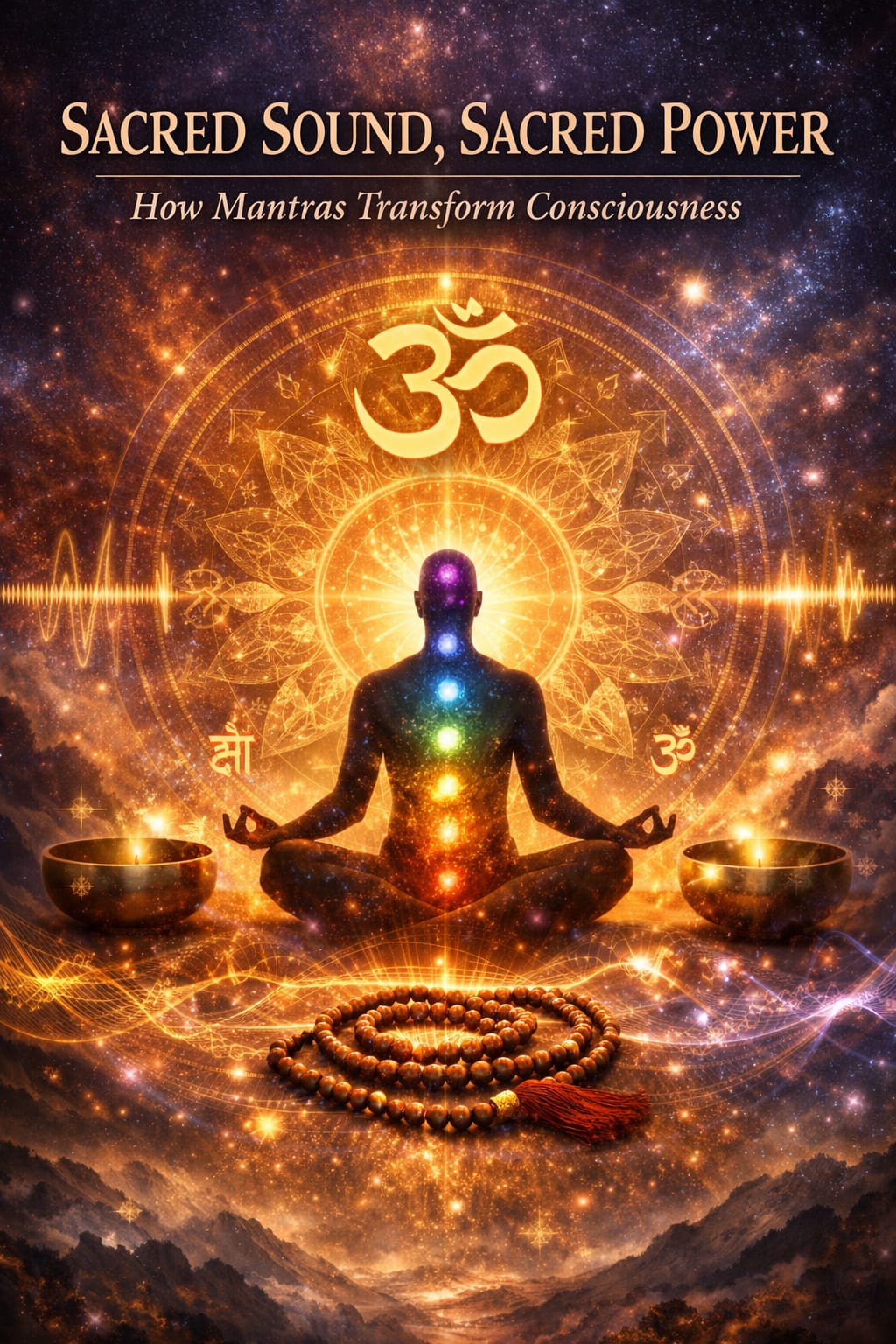
The Sound of the Infinite: How Mantras Connect Human and Divine
108 repetitions, which is a number sacred to Hindu tradition, corresponds to the mathematical ratio between the Sun, the Moon, and the Earth and is found throughout Vedic cosmology as a "number of wholeness and completion".
You have clasped your hands together in Prarthana. You have selected your Muhurta from the Panchang. And now, as the flame dances and the incense ascends, your lips open and a mantra pours forth. In this instant, something changes. The atmosphere is different. The mind, so agitated only seconds before, begins to calm like a tranquil lake.
It is no accident. This is the ancient wisdom of Mantra Shakti, the power of sacred sound at work.
What is a Mantra?
The term 'mantra' itself is derived from two Sanskrit words: 'manas', which means 'mind', and 'trana', which means 'liberation' or 'protection'. Thus, a mantra is essentially that which liberates the mind. It is not just a religious chant or a poetic couplet. It is a carefully designed vibrational formula, passed down through an unbroken chain of seers, to tune the human mind to the cosmic frequency.
The Rig Veda, the oldest of the four Vedas, begins with one of the most revered mantras in the world, the Gayatri Mantra, and asserts the efficacy of sacred speech from its very first hymn:
"Agnim ile purohitam yajnasya devam ritvijam, hotaram ratnadhatamam."
"I praise Agni, the divine priest of the yajna, the one who carries our offerings and illumines the path to the Divine."
— Rig Veda, Mandala 1, Sukta 1
Fire, sound, and purpose—the three components of every Vedic ritual—begin here. The mantra is the voice of the fire.
Sound as the Foundation of Creation
In the Hindu philosophical tradition, the universe itself is said to have emerged from sound. The Mandukya Upanishad states:
"Om iti etad aksharam idam sarvam."
"Om—this syllable is all this. All that was, all that is, and all that shall be—it is Om."
— Mandukya Upanishad, Verse 1
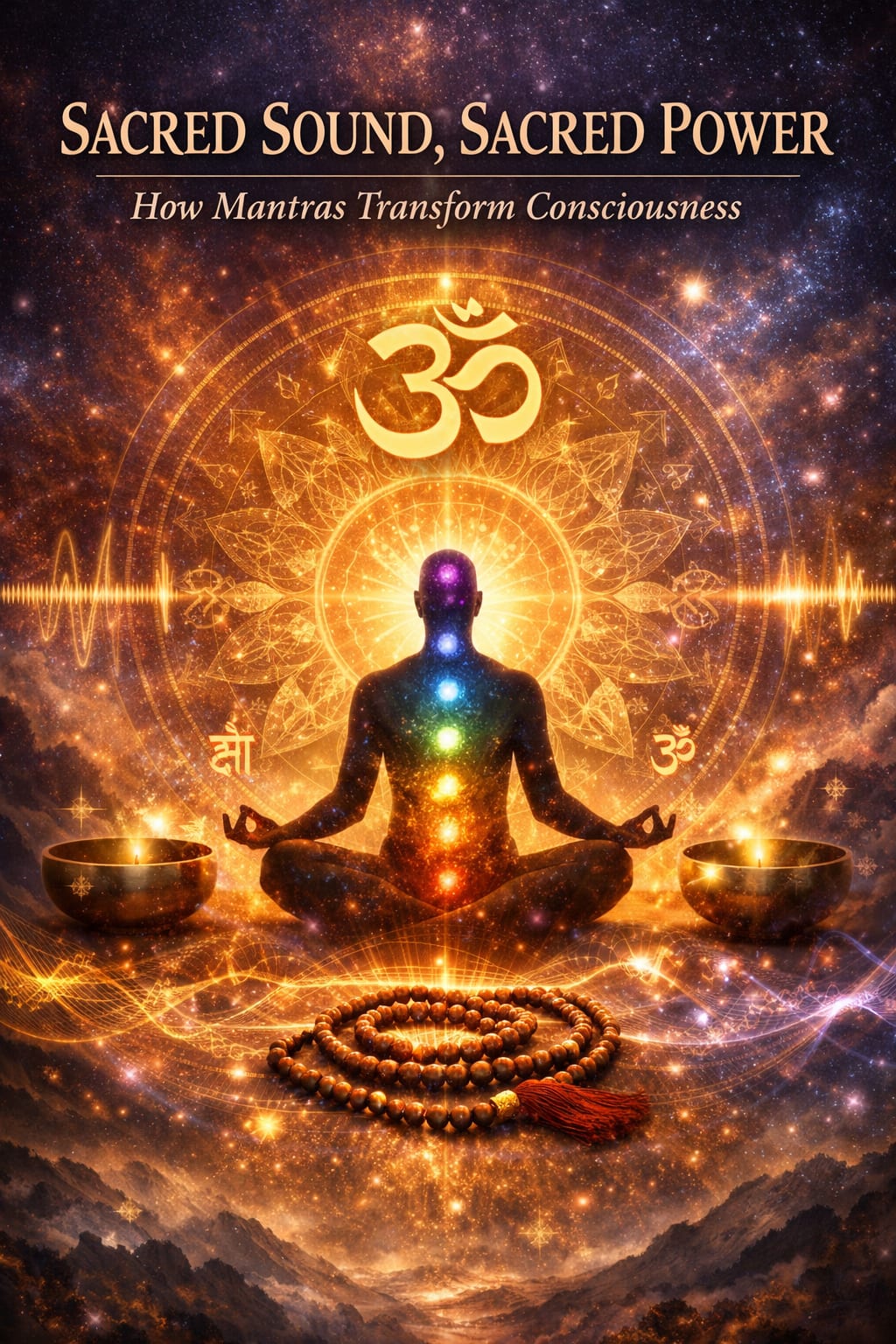
This is an astonishing assertion and one that modern physics is now approaching. Quantum physics informs us that at the subatomic level, matter is not material but vibrational. Everything that exists is, at its essence, a function of frequency and wave. The ancient rishis knew this not in the laboratory but through the subtle tool of deep meditative awareness.
When you say the syllable 'Om', you are not saying a word. You are tuning into the fundamental frequency of existence itself.
Different Mantras, Different Purposes
The Vedic school is remarkably subtle in its recognition that various mantras hold different powers, appropriate for different requirements of the soul.
The Mahamrityunjaya Mantra from the Rig Veda is chanted for healing, protection, and overcoming fear:
"Tryambakam yajamahe sugandhim pushti vardhanam, urvarukamiva bandhanan mrityor mukshiya mamritat."
"We worship the three-eyed Lord Shiva, who nourishes and spreads fragrance. May He liberate us from the bondage of death, as a ripe cucumber is released from its vine, granting us immortality."
— Rig Veda, Mandala 7, Hymn 59
The Gayatri Mantra from the Rig Veda is chanted for knowledge, understanding, and enlightenment by the divine. The Purusha Sukta is chanted during extensive yajnas. The Shri Suktam is chanted for abundance and the blessings of Lakshmi. Each mantra is a key – and each key unlocks a particular door in consciousness.
The Sama Veda, which is solely dedicated to the singing of these sacred mantras, recognizes this truth:
"Girah kavayah madhumad vadanti, tam mahinam pari sadma girbhih."
"The wise ones speak words sweet as honey, through these sacred sounds, they encompass the great Divine."
— Sama Veda
Why Repetition Matters: The Science of Japa
Among the most widespread practices in every tradition of Hinduism is Japa, which is the repetitive chanting of a mantra, usually counted on a mala consisting of 108 beads. To an uninitiated person, repetition may seem like a mere mechanical exercise. However, in the Bhagavad Gita, Japa is given the highest place among all spiritual practices:
"Yajnanam japa yajnosmi."
"Among all yajnas, I am the yajna of Japa."
— Bhagavad Gita, Chapter 10, Verse 25
Lord Krishna himself says that Japa is the greatest of all religious offerings. Why? Because with every repetition, the groove of that vibration gets further entrenched in the mind. Just as water carves stone, not by force but by persistence, Japa slowly and surely reduces the turbulence of the ego and exposes the calmness of the Self underneath.
108 repetitions, which is a number sacred to Hindu tradition, corresponds to the mathematical ratio between the Sun, the Moon, and the Earth and is found throughout Vedic cosmology as a "number of wholeness and completion".
Mantras in the Modern World
In a world of noise – notifications, news cycles, endless scrolling – the mantra provides something precious and rare: a sound that quiets all other sounds. The science of neuroscience has shown that the rhythmic chanting of the mantra stimulates the parasympathetic nervous system, lowers cortisol levels, and stimulates alpha brain wave activity, which is associated with calm focus and creativity.
But there is something that science cannot measure, something that is beyond the reach of research – the experience of sitting in the stillness of the early morning hours, the lamp burning before the deity, the mala passing through your fingers, and the mantra flowing like a river through your mind. It is in these moments that the separation between the one who prays and the One who is prayed to begins to break down.
This is the power of Mantra.
Speak the Sacred, Become the Sacred
Prayer, you set your intention. The Panchang synchronized your timing. Now, the Mantra propels your devotion straight into the heart of the Divine — like an arrow shot at the precise moment, in the precise direction.
The Atharva Veda says:
"Brahma varchasam aayusham, tejah kirtim shrutam balam, mantra balam param tejas."
"The highest radiance, the greatest strength — this is the luminous power of the Mantra."
— Atharva Veda
Start with one mantra today. Repeat it with conviction, with awareness, and with love. Use it as the string that weaves your mundane life into the fabric of the infinite.
Explore our sacred ritual offerings at Prarthanaverse, where every pooja is accompanied by the authentic chanting of Vedic mantras, performed by verified priests at sacred temples across India.
Om Namah Shivaya.